

How to Pay in China in 2026
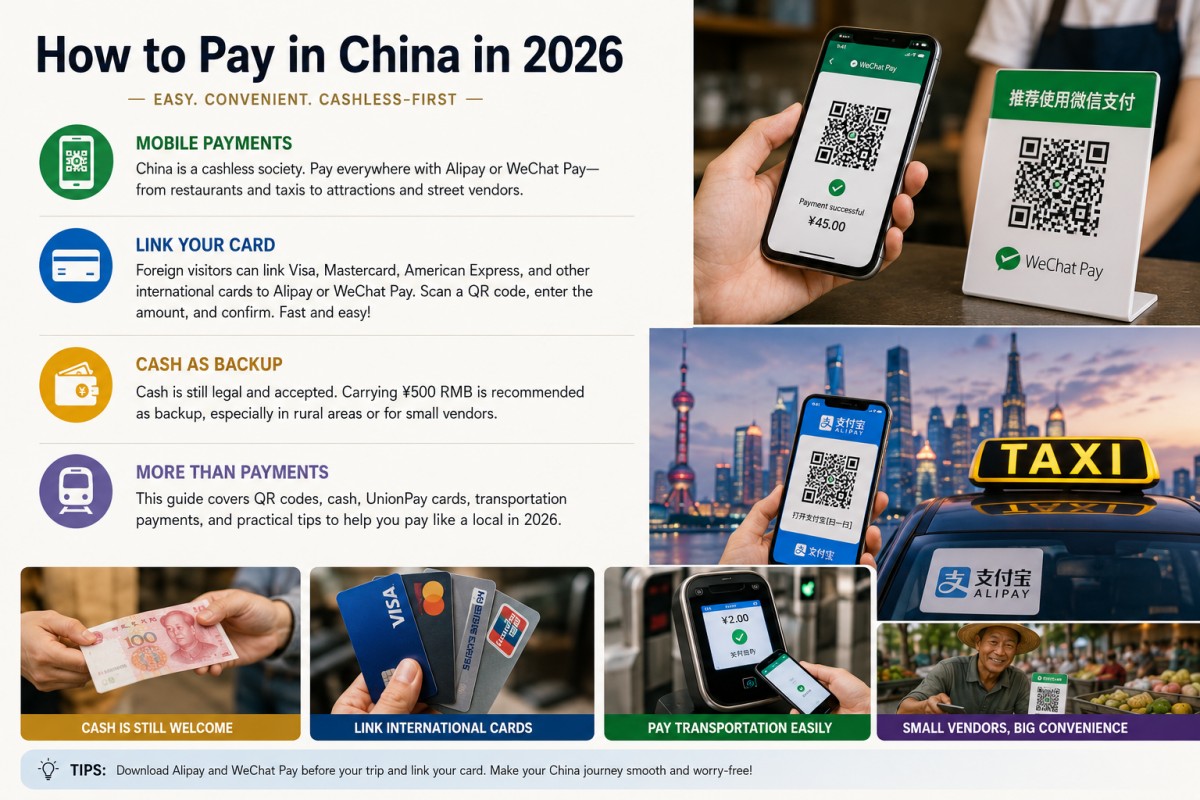
China has become one of the world’s most cashless societies. Most daily transactions—from restaurants and taxis to tourist attractions and street vendors—are completed via mobile payment apps like Alipay and WeChat Pay.
Foreign visitors can easily link Visa, Mastercard, American Express, or other international bank cards to these apps, enabling fast and convenient payments throughout Mainland China. Simply scan a QR code, enter the payment amount, and confirm.
Although cash is still legal tender and accepted by merchants, mobile wallets dominate daily life. Carrying ¥500 RMB is recommended as backup, especially in rural areas or for small vendors.
This guide explains everything tourists need to know about digital payments, QR codes, cash, UnionPay cards, transportation payments, and practical tips to pay like a local in 2026.
Mobile Payment Essentials
Alipay, WeChat Pay, QR codes, and digital wallets for everyday transactions.
Tourist Setup
Link international cards, verify your passport, and start paying before arrival.
Payment Options
Pay in restaurants, hotels, attractions, transportation, markets, and online platforms.
Cash & Backup
RMB cash, UnionPay cards, ATMs, and emergency payment solutions.
How Do Tourists Pay in China?
For most foreign visitors, the easiest way to pay in China is to use Alipay and WeChat Pay with an international bank card. China has developed into a highly digital and almost cashless society, so mobile payment is now the main payment method for daily transactions.
In Mainland China, you can use mobile payment apps to pay for meals, taxis, metro rides, high-speed train tickets, hotels, shopping malls, tourist attractions, convenience stores, street food, and even small local markets. Instead of swiping a credit card, most people scan a QR code or show a payment code to the merchant.
Cash is still legal tender in China, and merchants are required to accept cash payments. However, cash is no longer the most convenient option. Many small vendors may not have enough change, and most locals now prefer digital payments. For tourists, the best setup is to prepare Alipay, WeChat Pay, one international bank card, and around ¥300–¥500 RMB in cash as backup.
Main Payment Options in China
There are several payment options available for foreign visitors. The most useful ones are mobile wallets, bank cards, UnionPay cards, and cash.
| Payment Method | Best For | Tourist Friendly |
|---|---|---|
| Alipay | Restaurants, transport, attractions, shopping | Very High |
| WeChat Pay | Daily payments, mini programs, taxis, local services | High |
| International Bank Card | Hotels, airports, large malls | Medium |
| UnionPay Card | ATMs, stores, local card payments | Medium |
| Cash | Backup, remote areas, emergencies | Medium |
For most travelers, Alipay and WeChat Pay should be the first choice. International cards are useful in hotels and airports, but they are not accepted everywhere. Cash is helpful as a backup, especially in remote areas or when your internet connection is unstable.
Using Alipay in China
Alipay is one of China’s most widely used mobile payment platforms. It was launched by Alibaba Group and has become a daily payment tool for shopping, transportation, food, hotels, online services, and travel bookings.
Foreign visitors can download the Alipay app before arriving in China. You can register with a mobile phone number or email, then add your passport details and link an international bank card such as Visa, Mastercard, American Express, JCB, or Diners Club.
Once your card is linked, Alipay can be used in most major cities and tourist destinations. You can scan a merchant’s QR code, enter the payment amount, and confirm the transaction. In supermarkets and chain stores, the cashier may scan your Alipay payment code instead.
Alipay is especially useful for tourists because it has many travel-related services inside the app. You may find transportation payment, ride-hailing, hotel booking, ticket booking, exchange rate tools, and other services within one app. For first-time visitors, Alipay is often the easiest mobile payment app to start with.
How to Set Up Alipay Before Arrival
To avoid payment problems after landing, set up Alipay before your trip.
Download the Alipay app
Register with your mobile phone number or email
Add your passport details
Link your international bank card
Enable mobile payment services
Test the app with a small transaction if possible
Make sure the card details match your passport information. Some banks may block overseas transactions by default, so it is better to inform your issuing bank before traveling.
You also need internet access to use Alipay. A local SIM card, eSIM, or portable Wi-Fi device is recommended. Without mobile data, you may not be able to scan QR codes or confirm payments smoothly.
Using WeChat Pay in China
WeChat Pay is another major payment platform in China. It is built into the WeChat app, which is widely used for messaging, calls, social media, payments, mini programs, and local services.
Foreign visitors can use WeChat Pay by registering a WeChat account, verifying their identity, and linking an international bank card. Once activated, WeChat Pay can be used for daily payments across Mainland China.
WeChat Pay is especially useful because many Chinese businesses use WeChat mini programs. These mini programs allow users to order food, book taxis, buy attraction tickets, make appointments, and access local services without downloading separate apps.
For tourists, WeChat Pay is a strong backup to Alipay. Some small vendors may prefer WeChat Pay, while others accept both WeChat Pay and Alipay. Having both apps gives you better payment coverage during your China trip.
Alipay vs WeChat Pay: Which Is Better for Tourists?
Both Alipay and WeChat Pay are widely accepted in China, but they have slightly different strengths.
| Feature | Alipay | WeChat Pay |
|---|---|---|
| Foreign visitor setup | Easier | Good |
| English interface | Better | Moderate |
| QR code payments | Excellent | Excellent |
| Transport services | Strong | Strong |
| Mini programs | Good | Excellent |
| Peer-to-peer transfers | Good | Strong |
| Tourist services | Strong | Good |
For most tourists, the best choice is not one or the other. You should install both Alipay and WeChat Pay. If one app fails, you can quickly switch to the other. This is useful when paying small vendors, taxi drivers, restaurants, or local shops.
How QR Code Payments Work in China
Transportation payments in China are highly digital. In major cities, mobile payment is often the easiest way to use public transport.
You can use Alipay or WeChat Pay for many metro and bus systems. Cities such as Beijing, Shanghai, Guangzhou, Shenzhen, Chengdu, Hangzhou, Xi’an, and Chongqing support QR code-based transport payments.
For taxis, most drivers accept Alipay and WeChat Pay. Some also accept cash, but drivers may not always have change. Ride-hailing apps such as DiDi are usually connected to mobile payment platforms, making the process smoother.
For high-speed trains, travelers can book tickets through official platforms, travel apps, Alipay services, or WeChat mini programs. After booking, you can usually enter the station with your passport if the ticket is linked to your identity document.
Can You Use Cash in China?
Yes, you can use cash in China. The local currency is the Renminbi, usually called Chinese Yuan or RMB. One yuan equals 10 jiao, and one jiao equals 10 fen. The largest commonly used banknote is ¥100.
Cash remains legal tender, and merchants should accept cash payments. However, cash is less common in daily life. Many local people rarely carry cash, and some small vendors may not have change.
For foreign visitors, carrying ¥300–¥500 RMB is usually enough as backup. Cash is useful when your phone battery dies, mobile data stops working, your payment app fails, or you travel to remote areas.
Do not rely only on cash, especially in major cities. Mobile payments are usually faster and more convenient.
Can You Use International Bank Cards in China?
International bank cards can be used in China, but direct card acceptance is limited compared with mobile payment apps.
Visa, Mastercard, American Express, JCB, and Diners Club are more likely to be accepted at international hotels, airports, luxury malls, major tourist sites, and high-end restaurants. However, many smaller restaurants, shops, taxis, and local businesses may not accept foreign credit cards directly.
The better solution is to link your international bank card to Alipay and WeChat Pay. This allows you to use your foreign card through Chinese mobile payment platforms. It gives you access to a much wider range of merchants.
Before traveling, contact your issuing bank and confirm that overseas payments are enabled. This can prevent declined transactions after you arrive in China.
What About UnionPay?
UnionPay is China’s main domestic card network. It is widely accepted across Mainland China, including banks, ATMs, hotels, shopping centers, and many local businesses.
Some foreign banks issue UnionPay cards, and these can be useful in China. UnionPay debit cards are accepted more widely than many foreign credit cards. UnionPay Mobile QuickPass is also available as a contactless payment option, similar to Apple Pay or Google Pay.
However, most short-term tourists do not need to open a Chinese bank account or get a UnionPay card. For a normal China trip, Alipay, WeChat Pay, an international bank card, and backup cash are usually enough.
Do You Need a Chinese Bank Account?
Most tourists do not need a Chinese bank account to pay in China. In the past, foreign visitors often found mobile payment services difficult because many features required a Chinese bank account. Today, Alipay and WeChat Pay support international bank cards for many common travel payments.
A Chinese bank account may still be useful for long-term residents, business transactions, salary payments, or local financial services. But for short-term foreign visitors, it is usually unnecessary.
If you are visiting China for tourism, business meetings, exhibitions, or a short family trip, you can normally use payment apps with your international bank card.
Paying for Transportation in China
Transportation payments in China are highly digital. In major cities, mobile payment is often the easiest way to use public transport.
You can use Alipay or WeChat Pay for many metro and bus systems. Cities such as Beijing, Shanghai, Guangzhou, Shenzhen, Chengdu, Hangzhou, Xi’an, and Chongqing support QR code-based transport payments.
For taxis, most drivers accept Alipay and WeChat Pay. Some also accept cash, but drivers may not always have change. Ride-hailing apps such as DiDi are usually connected to mobile payment platforms, making the process smoother.
For high-speed trains, travelers can book tickets through official platforms, travel apps, Alipay services, or WeChat mini programs. After booking, you can usually enter the station with your passport if the ticket is linked to your identity document.
Paying in Restaurants, Cafes, and Local Markets
Restaurants in China commonly accept QR code payments. Many restaurants place QR codes on tables so customers can order and pay directly from their phones. Cafes, milk tea shops, bakeries, and fast-food chains also support mobile wallets.
At local markets and street food stalls, QR code payment is often preferred. A small vendor may have a printed Alipay QR code, a WeChat Pay QR code, or both. You scan the code, enter the payment amount, and show the confirmation screen.
Large restaurants in hotels or shopping malls may accept international cards, but smaller local restaurants usually prefer Alipay and WeChat Pay. For tourists, mobile payment apps provide the smoothest experience.
Paying at Hotels and Tourist Attractions
Most international hotels in China accept foreign credit cards. However, local hotels, guesthouses, and boutique stays may prefer mobile payment or UnionPay.
Tourist attractions increasingly support digital payments. Many attractions allow visitors to buy tickets through official websites, Alipay mini programs, WeChat mini programs, or travel platforms. Some scenic areas also use QR codes for entrance tickets, shuttle buses, cable cars, and restaurants inside the park.
If you plan to visit popular attractions during peak seasons, it is better to book tickets in advance. Mobile payments can help you avoid long lines at ticket counters.
Internet Access and Mobile Payments
Internet access is essential for mobile payments in China. Without a stable internet connection, you may not be able to scan QR codes, open payment apps, or confirm transactions.
Before your trip, prepare one of these options:
Local SIM card
eSIM with China coverage
Portable Wi-Fi device
International roaming plan
A local phone number can also be helpful for app registration, ride-hailing, restaurant reservations, and travel services. Some services may require SMS verification, so make sure your mobile phone number can receive messages.
If you plan to rely on mobile payments, do not arrive without a data plan.
Common Payment Problems and How to Fix Them
Even with proper setup, tourists may face payment problems in China.
Card Binding Failed
Check whether your card supports overseas online payments. Make sure your name, passport details, and card information are correct. Try another international bank card if the first one fails.
Payment Declined
Your issuing bank may block foreign transactions for security reasons. Contact your bank and enable overseas payments before traveling.
QR Code Not Working
Switch between Alipay and WeChat Pay. Some merchants may support one app better than the other.
No Internet Connection
Use hotel Wi-Fi, public Wi-Fi, or backup cash. A local SIM card is strongly recommended.
App Verification Problem
Double-check passport details, mobile phone number, and account information. Complete verification before your departure.
Best Payment Setup for Foreign Visitors
The safest payment setup for China is:
Alipay with an international bank card
WeChat Pay with an international bank card
One physical Visa or Mastercard
¥300–¥500 RMB cash
Local SIM card or eSIM
Backup power bank
This combination covers almost every situation, from major cities to small vendors and tourist destinations.
Final Tips for Paying in China
Before arriving in China, download both payment apps and complete account verification. Add your bank card, check your passport details, and make sure your phone has internet access.
During your trip, use Alipay or WeChat Pay for most payments. Keep cash as a backup, not as your main payment method. For hotels and airports, your international card may still be useful.
China’s payment system may feel different at first, but once set up, it is fast, convenient, and easy to use. With the right preparation, foreign visitors can pay smoothly across Mainland China without needing a Chinese bank account.
FAQ: Paying in China
What is the best way to pay in China as a tourist?
The best way is to use Alipay and WeChat Pay linked to an international bank card. Carry some RMB cash as backup.
Can foreigners use Alipay in China?
Yes. Foreign visitors can register, verify passport details, and link international bank cards.
Can foreigners use WeChat Pay in China?
Yes. WeChat Pay supports foreign visitors who complete verification and add a supported international card.
Do I need a Chinese bank account?
No. Most short-term tourists do not need a Chinese bank account.
Is cash accepted in China?
Yes. Cash is legal tender, but mobile payments are much more common.
Can I use Visa or Mastercard in China?
Yes, but direct acceptance is limited. It is better to link your card to Alipay or WeChat Pay.
Do street vendors accept mobile payments?
Yes. Most street vendors accept QR code payments through Alipay, WeChat Pay, or both.
How much cash should I bring to China?
Around ¥300–¥500 RMB is enough for backup in most travel situations.
Do I need internet access to pay in China?
Yes. Mobile payments require internet access, so prepare a SIM card, eSIM, roaming plan, or portable Wi-Fi.
Which is better, Alipay or WeChat Pay?
Both are useful. Alipay is often easier for tourists, while WeChat Pay is very common for daily life and mini programs. Use both for best coverage.
Get Inspired with Some Popular Itineraries